
Whether you’re a hobbyist, a professional operator, or an event planner curious about aerial spectacles, one question comes up constantly: how high can you fly a drone? The answer isn’t as simple as a single number — it depends on where you are, what type of drone you operate, and whether you have the right authorisations.
In this guide, we’ll break down the rules, the records, and how professional companies like Allumée push the limits of altitude and choreography in spectacular fashion.
The Legal Altitude Limit for Recreational Drones
In most countries, the default maximum altitude for recreational drone flights is 120 metres (approximately 400 feet) above ground level (AGL). This applies in:
- Europe (under EASA regulations, Open Category A1/A3)
- United Kingdom (CAA rules post-Brexit)
- United States (FAA recreational limits)
- Canada, Australia, and most of the Asia-Pacific region
This ceiling exists to keep consumer drones safely separated from manned aircraft, which typically operate at much greater altitudes but use low-level airspace for take-offs, landings, and helicopter operations.
Flying above this limit without authorisation is illegal in virtually every jurisdiction and can result in significant fines or criminal charges.
Can You Fly Higher ? Yes — With the Right Permissions
Altitude limits are not absolute walls. Professional and commercial drone operators can legally exceed the 120 m threshold under specific conditions :
Operational Authorisation (OA)
In Europe, operators in the Specific category can apply for an operational authorisation from their national aviation authority (e.g. DGAC in France, CAA in the UK, ENAC in Italy). This allows flights up to 150 m or higher, depending on the assessed risk.
Waivers (FAA – USA)
In the United States, Part 107 certified operators can apply for an altitude waiver from the FAA. These are assessed on a case-by-case basis, factoring in proximity to airports, airspace class, and operational procedures.
Special Use Airspace
Military, scientific, and emergency services can operate at far greater altitudes — sometimes thousands of metres — through controlled airspace agreements.
How High Have Drones Actually Flown?
While consumer drones are capped at 120 m for legal and safety reasons, the technical potential of drones is far greater:
- Consumer drones like the DJI Mavic series have a service ceiling of approximately 5 000–6 000 m above sea level.
- Professional UAVs used in surveying or telecommunications relaying can exceed 10 000 m.
- High-altitude pseudo-satellites (HAPS) — drone-type aircraft — operate in the stratosphere at altitudes of 20 000 m and beyond.
These numbers are theoretical maximums, not operational targets. In practice, the question how high can you fly a drone is always answered within the boundaries of local regulation.
Altitude in the Context of Drone Light Shows
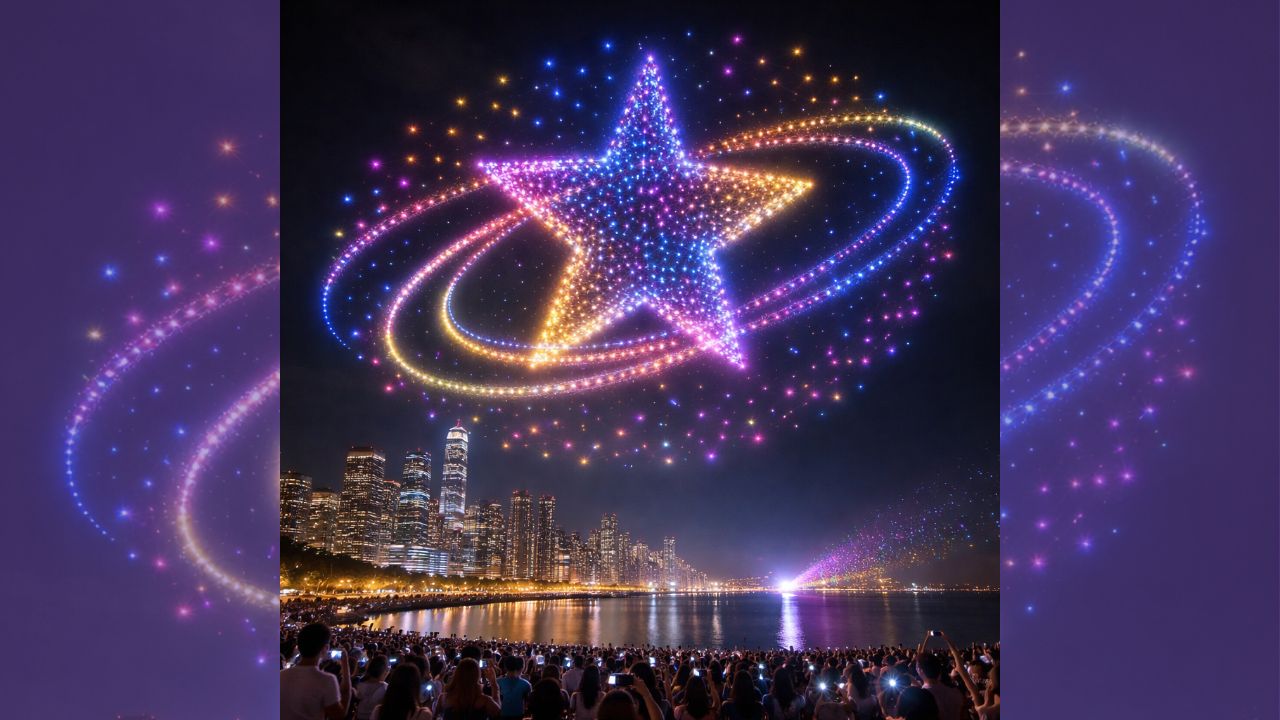
One of the most spectacular applications of drone technology in recent years is the drone light show — a choreographed aerial performance using dozens or hundreds of illuminated drones flying in tight formation.
For drone light shows, altitude is a critical design parameter:
- Minimum safe altitude: 50–80 m to ensure visibility and separation from spectators.
- Typical performance altitude: 80–150 m, offering the best balance of visual impact and safety margins.
- Maximum used in performances: around 150–200 m for dramatic climax moments, always within authorised limits.
Companies like Allumée design their formations at altitudes that maximise visual impact while fully complying with aviation regulations. Every show requires prior coordination with aviation authorities, notam publication, and risk assessment — altitude is never an afterthought.
How Much Does a Drone Light Show Cost ?
Altitude and fleet size are two of the primary factors that influence pricing. A show using 50 drones at 100 m has very different operational requirements — and costs — from a 300-drone performance at maximum authorised altitude.
If you’re curious about investment, Allumée provides transparent information about their packages. You can explore drone light show price options directly on their pricing page, where shows are detailed according to fleet size and event type.
Pricing typically covers:
- Pre-show programming and animation design
- Logistics and drone transport
- Regulatory filing and airspace coordination
- On-site crew and technical support
- Safety equipment and exclusion zone management
Why Altitude Matters for Your Event
If you’re considering a drone light show for a corporate event, public festival, or private celebration, altitude directly affects :
Visibility radius — the higher the drones, the further the show can be seen. A show at 120 m is visible from several kilometres away under clear conditions.
Formation scale — higher altitude allows larger formations to appear coherent and proportioned to the human eye at ground level.
Safety perimeter — increased altitude generally requires a larger ground exclusion zone, which impacts venue planning.
Regulatory complexity — the higher the intended altitude, the more detailed the authorisation process with the national aviation authority.
Working with an experienced operator like Allumée means all of this is handled professionally, leaving you to focus on the experience rather than the paperwork.
Key Takeaways
- In most countries, the legal limit is 120 m AGL for recreational drones.
- Professional operators with authorisation can fly higher than 120 m, up to 150 m or more.
- Drone light shows typically operate between 80 and 150 m, fully within regulated parameters.
- Altitude is a key design variable that shapes the visual scale and safety requirements of aerial performances.
- Working with a certified operator ensures every flight respects the rules — and delivers an unforgettable show.
